

Breeding Notes
Ceratogyrus darlingi
Rear-horned baboon tarantula
Also known as: Darling's horned baboon, African rear-horned baboon, burst horned baboon
Species-specific breeding guidance, seasonal context and practical caveats for experienced keepers.
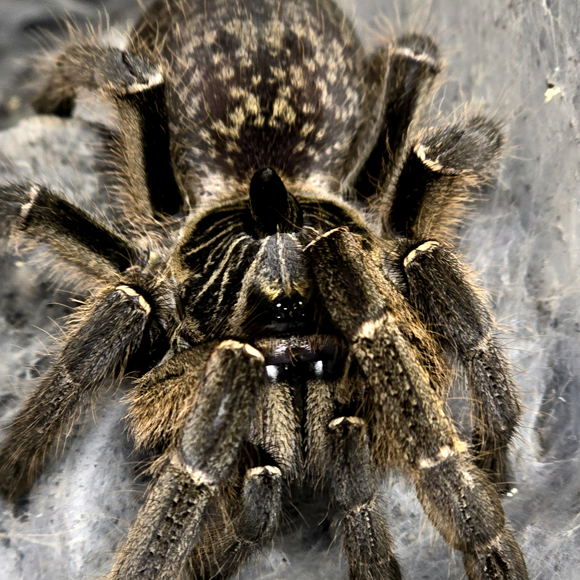
Species breeding reference
Breeding Notes
Ceratogyrus darlingi is an advanced-level breeding project. Wild breeding likely aligns with the wet summer months in southern Africa. In captivity, after a careful introduction and timely removal of the male, a female often produces an egg sac in about 4–6 weeks under warm, slightly humid but well-ventilated conditions. Spiderling counts can be high, but overall reports are sparse—so treat this as cautious guidance based on limited species-specific and related-data.
Wild Breeding Season
Reports vary, but it is thought that breeding in the wild tends to coincide with the rainy season in its southern African range—typically the wet months from around November to March—though exact timing for Ceratogyrus darlingi is poorly documented.
Wild Environmental Triggers
Rainfall appears to be the key seasonal trigger, with breeding activity aligned with the wet season when conditions are more favourable for egg development and spiderling survival.
Native Climate Context
This species inhabits dry grassland and savannah regions of southern Africa (e.g. Zimbabwe, Botswana, South Africa), with a distinct wet season in summer months (roughly November through March) and long dry season; climates are warm, with mean temperatures ranging from around 22 °C in transitional seasons to over 25 °C in summer, and humidity peaking in wet months but generally remaining moderate.
Captive Breeding Window
In captivity, females often produce an egg sac about 4–6 weeks after mating, provided the temperature is kept around 24–28 °C and humidity is moderate, around 60 % (tweaked with ventilation to avoid stagnant moisture).
Pre-pairing Conditioning
Both male and female should be well-fed and in good body condition; females that are well-fed may accept a male more readily and are less aggressive during pairing.
Male Introduction Guidance
Introduce the male when the female appears receptive; once mating appears complete (drumming or allowing emboli insertion), remove the male immediately to reduce the risk of the female attacking.
Female Readiness Signs
A well-fed, settled female who is no longer excessively defensive, and who exhibits drumming or stillness during courtship, likely indicates readiness.
Post-pairing Conditions
Maintain temperatures of about 24–28 °C and moderately elevated humidity (around 60 %) with good ventilation; provide a shallow water dish and keep the female undisturbed to encourage egg sac development.
Sac Timeline
An egg sac typically appears around 4–6 weeks post-mating.
Incubation Notes
If left with the mother, spiderlings usually emerge in about 6–8 weeks; some breeders choose to remove the egg sac at 30–40 days for artificial incubation, which can also be successful.
Expected Sling Count
Reported counts vary but range from approximately 100 to 300 spiderlings per sac.
Risks and Cautions
Females are highly defensive and fast—males must be removed promptly post-mating. High humidity or poor ventilation can be harmful—avoid swampy conditions. Data are limited, and some figures (e.g. sling count, incubation) are derived from comparable reports or genus-level inference rather than abundant species-specific studies.
Evidence confidence: Medium